Home› Health Guides› Pediatrics
Childhood Immunizations: What They Protect Against, and What the Schedule Is For
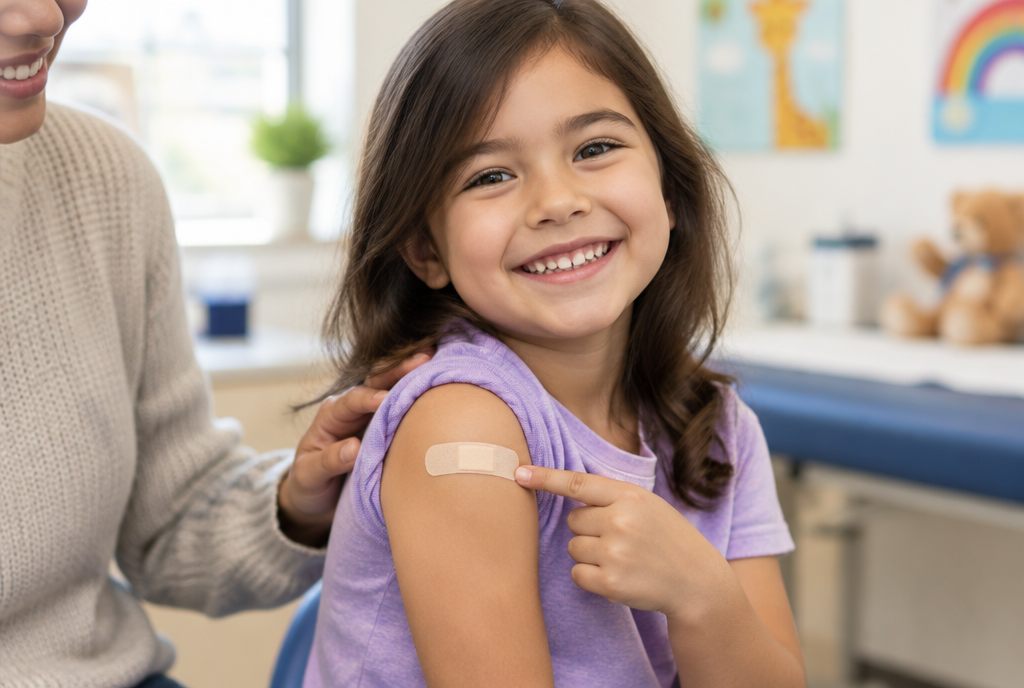
If you are here because a school or child care centre asked for an immunization record, bring your child in and we will go through it with you. We can tell you what is on file, what is due, and what to do if the records are incomplete or in another state’s system — and you do not need to have it sorted out before you call.
That is the practical answer. The rest of this page is the part parents actually ask about in the room, which is not whether to vaccinate so much as why this many, why this young, and why on this timetable.
The schedule is built around when a child is vulnerable, not when it is convenient
This is the single thing most worth understanding, and almost nothing written for parents says it plainly.
Vaccines are not scheduled early because early is tidy. They are scheduled to close a specific gap. A newborn carries some of their parent’s antibodies for a few months, and those fade. At the same time, a baby’s immune system is least able to contain certain infections — which is exactly the argument at the top of our fever page, where any fever under one month is an emergency for the same reason.
So the most dangerous window and the least protected window are the same window, and the schedule exists to arrive before it rather than during it. Whooping cough is the clearest example: it is most lethal in the first months of life, which is why the vaccine starts at two months and why adults around the baby are offered a booster. Waiting until a child is older is not a cautious version of the schedule. It is a decision to leave the riskiest months uncovered.
The same logic explains the repeats. A second or third dose is not a correction of the first — many vaccines need more than one exposure to produce durable protection, and the intervals are set by how the immune response actually develops.
What is on the list, in plain terms
| Protects against | Why it is on the list |
|---|---|
| Whooping cough (pertussis) | Babies stop breathing from it. Given as DTaP with tetanus and diphtheria. |
| Measles | Among the most contagious infections known, and it can cause pneumonia and brain inflammation. Given as MMR. |
| Mumps and rubella | Mumps can affect hearing and fertility; rubella in pregnancy causes severe birth defects. |
| Hib | Once the leading cause of bacterial meningitis in young children in the US. Most parents have never heard of it, which is the vaccine working. |
| Pneumococcus | Pneumonia, meningitis, and the ear infections that keep recurring. |
| Rotavirus | The dehydration that used to hospitalise infants routinely. An oral dose, not a shot. |
| Polio | Paralysis. Still circulating in parts of the world, and travel is why it stays on the list. |
| Hepatitis B | Can be caught at birth and cause liver disease decades later. |
| Hepatitis A | Foodborne, and Arizona runs higher rates than much of the country. |
| Chickenpox (varicella) | Usually mild, occasionally not — and it is the same virus that returns later as shingles. |
| HPV | Prevents cancers, given in adolescence because it has to be given before exposure to work. |
| Meningococcus | Rare, and it can kill a healthy teenager in a day. Required by many colleges and dorms. |
| Influenza | Annually, because the virus changes. Our flu page covers the timing. |
| COVID-19 | Current recommendations change; ask us what applies to your child now rather than relying on a page. |
Tetanus deserves a note of its own. It is not contagious — you cannot catch it from another person. It lives in soil and dust, which in the desert is not a theoretical exposure. A puncture wound from a nail, a thorn, or a fall in a yard is the classic route, and immunity fades, so the booster interval matters into adulthood.
What parents actually ask us
“Is it too many at once?” The number of vaccines went up; the number of immune components in them went down substantially, because modern vaccines use targeted pieces rather than whole organisms. A child’s immune system handles vastly more in an afternoon at a playground. The reason doses are combined is that combining them is what makes the schedule achievable — split into separate visits, some doses reliably get missed, and a half-finished series protects less than the schedule it came from.
“Can we spread them out?” You can ask us, and we will talk it through rather than end the conversation. What we will tell you honestly is that the alternative schedules circulating online were not designed against disease risk — they extend the window where a child is unprotected, and they add visits and needles rather than removing them. If cost, timing, or a bad previous experience is the real obstacle, say so. Those are solvable and we would rather solve them.
“My child is sick — should we skip today?” A mild illness, including a low fever, a cold, or a course of antibiotics, is generally not a reason to postpone. A significantly unwell child is. Tell us what is going on and we will decide at the visit.
“What about a reaction?” Most are a sore arm, a mild fever, fussiness, or sleepiness for a day. Those are common and expected. Serious reactions are rare, and the reason we ask you to wait a short while afterwards is that the rare ones happen quickly and are treatable when someone is there. Call us about a fever above 104°F, a reaction that worsens after 48 hours, inconsolable crying for more than a few hours, or a swelling that keeps spreading. Call 911 for difficulty breathing, facial or throat swelling, hives spreading over the body, or collapse.
“Does my child still need this if the disease is gone?” Most of these are not gone. They are suppressed, in this country, by the fact that most children are vaccinated — and several are one imported case away from a local cluster. Measles is the one that demonstrates it: outbreaks in the US in recent years have started with a single traveller and spread through communities with lower coverage. A disease you never see is the outcome, not the reason to stop.
“What if we have fallen behind?” Then we catch up. There is a proper catch-up schedule for a child who started late, missed doses, moved between states, or arrived from another country — and it does not mean starting over. This is one of the most common reasons families come in and one of the least worth being embarrassed about.
The Arizona part
Schools and child care centres ask for an immunization record at enrolment, and the state publishes the list of what is required and which exemptions exist. Arizona also runs a statewide immunization registry, which is usually how we can find doses given at another practice, a pharmacy, or a health department clinic when your paperwork is incomplete. If your family has moved — and in Maricopa County most have — that registry is often the fastest way to reconstruct a record.
Arizona’s personal-exemption rate has been climbing, and coverage in some schools now sits below the level at which measles stops spreading. That is not an argument aimed at anyone; it is the reason the question “is this still necessary here” has a different answer in some Phoenix-area schools than the national figures suggest.
And two things no vaccine covers, because they come up here constantly. There is no vaccine for Valley fever, the soil fungus that causes a large share of Arizona pneumonia — our Valley fever page covers what to do instead. And no vaccine addresses heat illness, which is the other genuinely local threat to a child’s health in this state.
What a visit actually looks like
We check the record first, tell you what is due and what is not, and give you the chance to ask before anything happens. If you want to talk through a specific vaccine, that is a normal use of the appointment and not an imposition — we would much rather have the conversation than have you skip the visit to avoid it.
Immunizations are usually given at well-child visits, which is the main reason those visits are scheduled when they are. If your child is behind on visits as well as doses, start with the visit.
Sources
- Vaccines — immunizations — MedlinePlus Medical Encyclopedia, U.S. National Library of Medicine. https://medlineplus.gov/ency/article/002024.htm
A note on this article: This information is general health education and is not a substitute for a visit with a provider. If you have a concern about your health or your family’s health, call us and we will help.