Home› Health Guides› Arizona Health
Sun Protection and Skin Cancer in Arizona: What Actually Reduces Your Risk
Arizona has one of the highest rates of skin cancer in the United States. That is not a scare line — it is the reason this page is written for here rather than copied from somewhere with four seasons.
And it comes with an unusually good piece of news: skin cancer is among the most preventable cancers there is, and among the most curable when it is found early. Both halves of that sentence are things you can act on.
Check this one thing first
A spot that is changing is more important than a spot that looks odd.
Most people have moles, freckles and sun spots that are entirely harmless and have looked that way for years. What deserves attention is change — and the useful checklist is five letters:
- A — Asymmetry. One half does not match the other.
- B — Border. Edges that are ragged, notched or blurred rather than clean.
- C — Colour. More than one colour in the same spot, or colour that has shifted.
- D — Diameter. Larger than about 6mm, roughly a pencil eraser — though smaller ones can matter too.
- E — Evolving. Changing in size, shape, colour, or starting to itch, bleed or crust.
E is the one that matters most, and it is the one a checklist can miss. A spot that is different from how it was six months ago is worth showing us, whatever it scores on the other four.
Two more worth knowing, because they are not moles and do not fit the letters:
- A sore that does not heal. A patch that scabs, heals a little, then breaks open again over weeks. This is the commonest presentation of the commonest skin cancers, and it gets dismissed as a scratch for months.
- A rough, scaly patch that does not clear with moisturiser, often on the face, ears, scalp or forearms.
And the odd-one-out rule: if one spot on your body simply does not look like the others, show us that one. People are better at this than any checklist — it is worth trusting.
The three kinds, briefly, because the differences matter
Basal cell carcinoma is the most common by a wide margin. It grows slowly, very rarely spreads, and is usually straightforward to remove. It shows up as a pearly bump, a flat scaly patch, or that sore that will not heal.
Squamous cell carcinoma is next most common. It can spread if left, so it is treated more promptly — often a firm red nodule or a crusted, scaly patch.
Melanoma is much less common and the one that matters most, because it can spread early and because early removal is usually curative. That single fact is why this whole page exists: the difference between a melanoma caught at a few millimetres and one caught a year later is the difference between a minor procedure and a serious illness.
None of these can be diagnosed from a photograph or a website. What a page can do is get you looked at sooner.
What actually works, in the order it works
1. Shade and timing beat everything else. Ultraviolet radiation here peaks roughly between ten in the morning and four in the afternoon. Moving an outdoor activity to early morning or evening does more than any product, and in an Arizona summer you were probably going to do that anyway for the heat.
2. Clothing beats sunscreen, because it does not wear off, does not get missed, and does not need reapplying. A long-sleeved shirt, a wide-brimmed hat that actually shades the ears and neck, and sunglasses that block UV. Fabric rated UPF is genuinely better, and ordinary tightly-woven clothing is already good.
3. Then sunscreen, on what clothing does not cover:
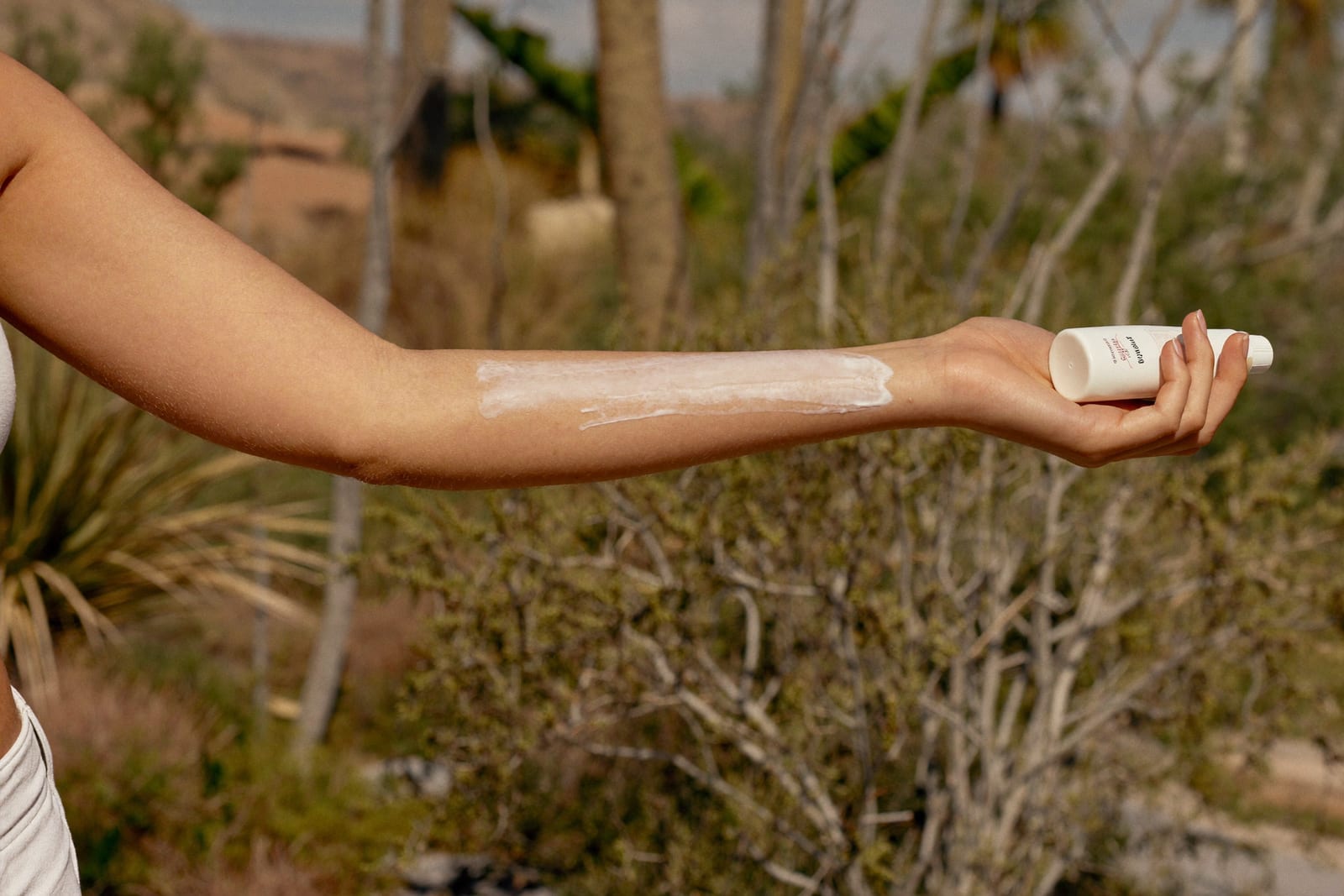
- Broad spectrum, SPF 30 or higher. Broad spectrum matters as much as the number — it means UVA as well as UVB.
- More than you think. Most people apply about a quarter of the amount products are tested at, which turns an SPF 30 into something much lower in practice.
- Every two hours, and immediately after swimming or heavy sweating. “Water resistant” buys you forty or eighty minutes, not a day.
- The places everyone misses: ears, the back of the neck, the tops of the feet, the hairline and any thinning patch of scalp, and the lips — which need a balm with SPF, not lotion.
- Mineral sunscreens (zinc oxide, titanium dioxide) suit sensitive and children’s skin, and are what we suggest for babies over six months.
- Under six months: keep them out of direct sun rather than relying on sunscreen. Shade, clothing and timing.
4. No tanning beds. Ever. There is no safe tan from a machine, and using one before about age 35 substantially raises melanoma risk. A “base tan” offers almost no protection and is itself sun damage.
5. Windows, cars and cloud. UVA passes through window glass, so a long commute exposes one arm more than the other — a pattern dermatologists genuinely recognise. And thin cloud passes most UV through: an overcast Phoenix afternoon is not a day off.
The Arizona parts a national page will not tell you
Altitude and clear air. UV rises with elevation and with cloudless days, and this state has a great deal of both. Flagstaff and the rim country are meaningfully stronger than Phoenix for the same clock time.
Winter is not a break. A February hike at midday here delivers more UV than a summer afternoon in much of the country. The heat is what stops people going out in July, and the heat is not the risk being managed.
Reflected UV adds up. Water, sand, concrete and pool decks bounce it back up, which is how people burn the underside of the chin and the backs of the knees.
And the thing worth saying plainly: the same climate that makes this a pleasant place to live year-round is the reason the risk is higher here. A childhood spent outdoors in Arizona carries more accumulated exposure than a childhood spent outdoors almost anywhere else in the country, and most lifetime sun damage happens before adulthood. Which makes sun habits a children’s health topic as much as an adult one — hats and shade in early childhood are a long-term intervention, not fussiness.
Who should be more careful
Risk is higher with fair skin that burns easily, red or blond hair, light eyes, many moles or unusual-looking moles, a history of bad sunburns — especially blistering ones in childhood — a personal or family history of skin cancer, a suppressed immune system, or long-term outdoor work.
One honest caveat that is often left out: skin cancer occurs in people with brown and black skin too, it is diagnosed later on average, and it more often appears in places people do not check — palms, soles, under nails, and inside the mouth. Darker skin offers real but partial protection, and “I don’t burn” is not the same as “I am not at risk.”
Call us if
- Any spot is changing — size, shape, colour, or newly itching, bleeding or crusting
- A sore that has not healed in a month
- A rough scaly patch that does not clear
- One spot that simply does not look like your others
- A new dark streak under a fingernail or toenail, or a new dark spot on a palm or sole
- You have never had a skin check and you have any of the risk factors above
- You have had a skin cancer before — recurrence and second cancers are common enough that follow-up matters
- Your child has had a blistering sunburn, or you want help building habits that stick
What we do: look, measure and photograph anything worth watching, treat what is straightforward, and refer to dermatology for anything needing a biopsy or specialist removal. Bring a list of the spots that concern you; people forget them in the room.
The realistic version
Nobody in Arizona avoids the sun, and a page telling you to would be ignored. What changes outcomes is the boring stuff done routinely: a hat that lives in the car, sunscreen kept where you will actually reach for it, outdoor time shifted earlier, and a look at your own skin every few months so you notice change while it is small.
That last habit is free, takes five minutes, and is the single most effective thing on this page.
Sources
- Sunburn — MedlinePlus Medical Encyclopedia, U.S. National Library of Medicine. https://medlineplus.gov/ency/article/003227.htm
- Melanoma — MedlinePlus Medical Encyclopedia, U.S. National Library of Medicine. https://medlineplus.gov/ency/article/000850.htm
A note on this article: This information is general health education and is not a substitute for a visit with a provider. If you have a concern about your health or your family’s health, call us and we will help.